Interviews
CALLSIGN Publishing — Interview Quotes
-
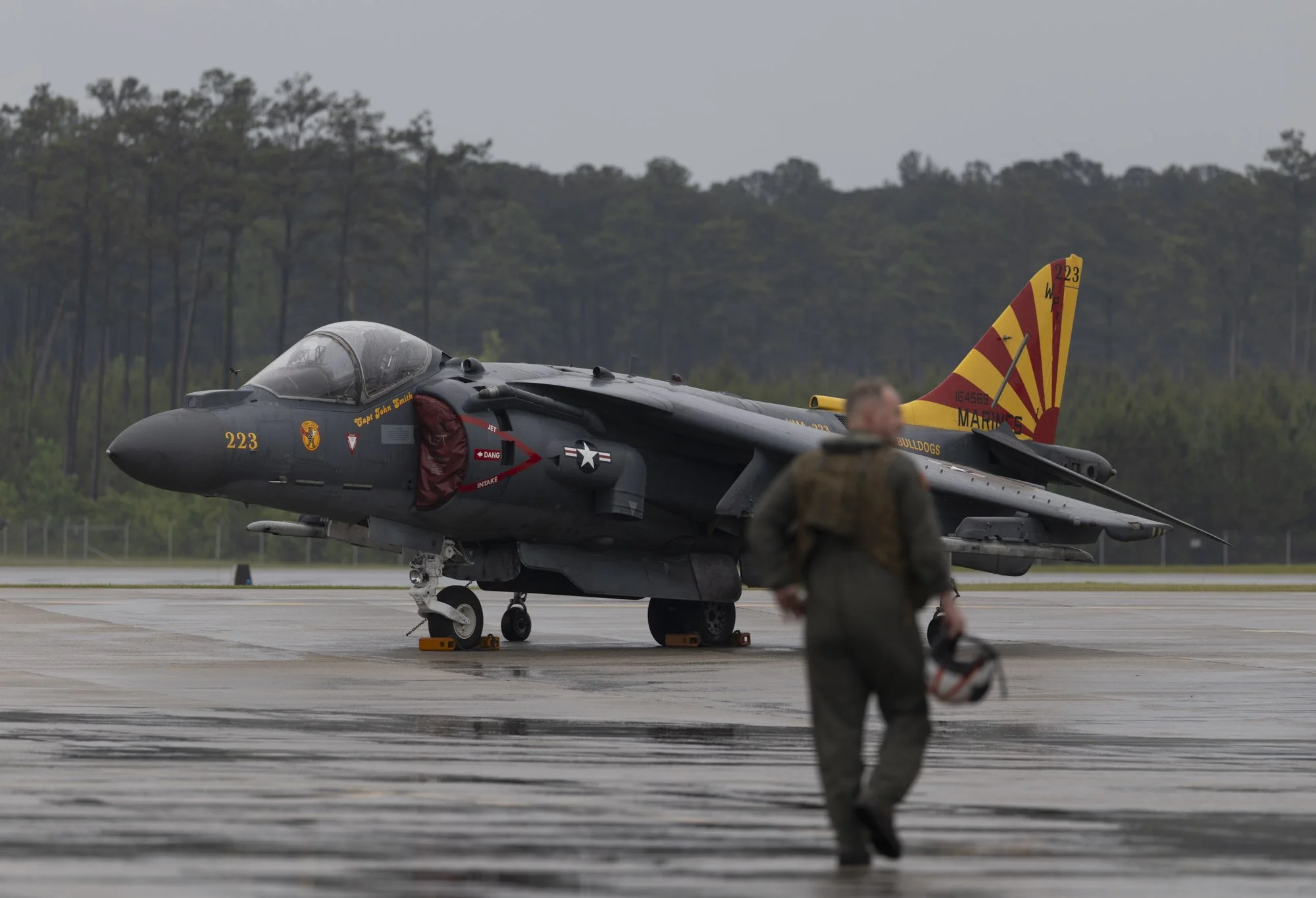
“If you can fly the Harrier well, you can fly just about anything. I’m convinced of that because the Harrier, being a V/STOL jet and no fly-by-wire, no magic — you do it all. It’s stick and rudder. You really had to be thinking about what you’re doing… you had to have a very smart left hand, because your left hand controlled both the throttle and the nozzle control lever, which are right next to each other, and they both moved in the same direction.”
Ben “Lawman” Hancock
-
“The Harrier had the beauty to be whatever the Marine Corps needed it to be. Jets loaded with six 500‑pound bombs, full gun, and external tanks, then dragged through winter weather and tanker chains from the Persian Gulf to Kuwait, Iraq, and Syria for eight‑ and nine‑hour missions in support of Kurdish forces and U.S. special operations teams.”
Nick “Fokker” Wineman
-
“The Harrier was a Swiss‑Army‑knife CAS (close‑air support) jet. We showed up with mixes of APKWS (Advanced Precision Kill Weapon System), laser‑guided bombs, and heavier ordnance. The jet can answer what the JTAC needs that day or night. You tell me what you want and I’m going to give you the best weapon.”
Trevor “Havya” Felter
-
“We have George, so we have a poor man’s autopilot, so it will maintain straight and level. But I’ve flown in jets to where there’s a leak in the system, and George feels like a roller coaster. It just goes up 100 feet, and then it goes down 100 feet."
Trevor “Havya” Felter
-
“A lot of flying Harriers was all tribal knowledge, with retired Harrier pilots coming back to teach ground school and in the simulator. That single‑seat, single‑engine attack mindset gets passed down.”
John “Traper” Cumbie
-
“The Harrier is the ultimate example of flexible basing. Boats, grass, dirt, metal, parking lots…they all looked like viable options to the Jump Jet and a V/STOL pilot.”
Derek “Loob” Mills
-
“One of the things that keeps me engaged is the difficulty of flying the aircraft. You never have this aircraft mastered… in a split second, if you want to rip the wings off, it’ll let you do it. It’s probably one of the last non-fly-by-wire aircraft out there. So it’s fun because it’s challenging.”
Eric “Porky” Scheibe
-
“There’s one word that describes the CAS mission... Righteous. You went lower, released lower. You exposed yourself because you were consciously connected to those guys on the ground.”
Jack “Blaster” Brown
-
“It was kind of a once-in-a-generation, once-in-a-lifetime thing. It’s the last day we’re ever flying these things, so you really want to take it all in and be there with the people that you care about. We really just wanted to do right by all of them—the community, those who came before, all the blood, sweat, and tears put in over the years by Marines, families, and those who didn’t come home.”
John “Traper” Cumbie
-
“We supported the entire Al Anbar Province for almost eight months, 24 hours a day, without stopping. You literally eat breakfast with the guys you’re going to be supporting that night. They pull out the map and tell you what they’re worried about, so even if comms go down, you already know where you need to be looking. Everything you do is focused around putting ordnance on target, on time. From day one, that gets beaten into you.”
Dave “Burt” Lancaster
-
“Across 55 years, the story is one of remarkable tenacity and determination to make an unconventional approach work, because the Marine Corps recognized that in a major war, we’re not going to have the big airbases — and even our big carriers are going to be at risk… I think the F-35 is the end result of 55 years of the Harrier struggle.”
Tom “Shine” Gore
-
“It was just such a small community, and it was Marine Corps only… we had a small mission, and we did it well — a very precise mission. I’ll miss the sound of the Harrier on our flight line… I love the sound of that. But really, if I boil down everything I’ve rambled on about here, it’s going to be the people — that team.”
James “Jimbo” Coppersmith
-
“It’s probably the last, if not one of the last, aircraft that you are actually flying — there’s no computer in the loop. It’s wires, hydraulic actuators. That part of it’s fun is you’re actually flying it. You actually get to interact with the aircraft, feel the aircraft, and feel what it does.”
Alec “Cosmo” Rackish
-
“Tom Miller went over to England… and said that has the potential for working, and he convinced the Marine Corps to give up a couple of squadrons of F-4s to try out three squadrons of Harriers, 110 airplanes that we converted into an AV-8A… Just all single seaters, no simulators, and an airplane that flies in a flight regime that nobody had ever really spent much time in.”
Harry “Vulture” Blot
-
“Each Harrier had its own personality… You could hear that starter motor pitch a little bit higher for a little too long. It was telling you if you just listened. No matter the mission, and how absolutely absurd the objective was… the maintainers, the officers, just the overall professionalism — there was always a way. And every task that was ever set in front of us, we accomplished it.”
Julia Koch — Maintainer
-
“First of all, I want to give my accolades to the mechanics… very challenging airplane to maintain. The guys, the Pegasus — those guys busted their butt on that airplane, not just the engine, but the airframe.”
Ben “Lawman” Hancock
-
“The thing I hated the most was when they started painting them gray. I loved the camouflage because that made it feel Marine. It’s just awe-inspiring to sit in there and run that baby up and feel that power. It is just an amazing aircraft.”
Bob Enfinger — Avionics
-
“When you actually put the time in to learn your craft, and you understand how to fly the jet...you feel like you’re ahead of the jet, or at the peak of your abilities. I mean, it is enjoyable to fly. The thing accelerates like no other. It’s very light... you can get off the ground a few hundred feet... and then you’ve hit almost 400 knots by the end of the runway... it’s just unbelievable the performance of this aircraft down low.”
John “Traper” Cumbie
-
“It’s not something you get a light telling you, hey, there’s this issue. It’s one of those things you have to diagnose because you lose most everything that would tell you anything. Roughly fifty minutes into the emergency, on final approach, the engine quit entirely. I go through those three procedures and I don’t have anything. So I put my head back and pull the handle. Luckily, I ejected safely.”
Will “Gump” Pollard
-
“We did 24-hour ops for almost 8 months… we had 10 jets, and we supported the entire Anbar province for that entire period, 24 hours a day, without stopping.”
Dave “Burt” Lancaster
KICKSTARTER
Campaign Launch
Be the first to reserve a copy of the book
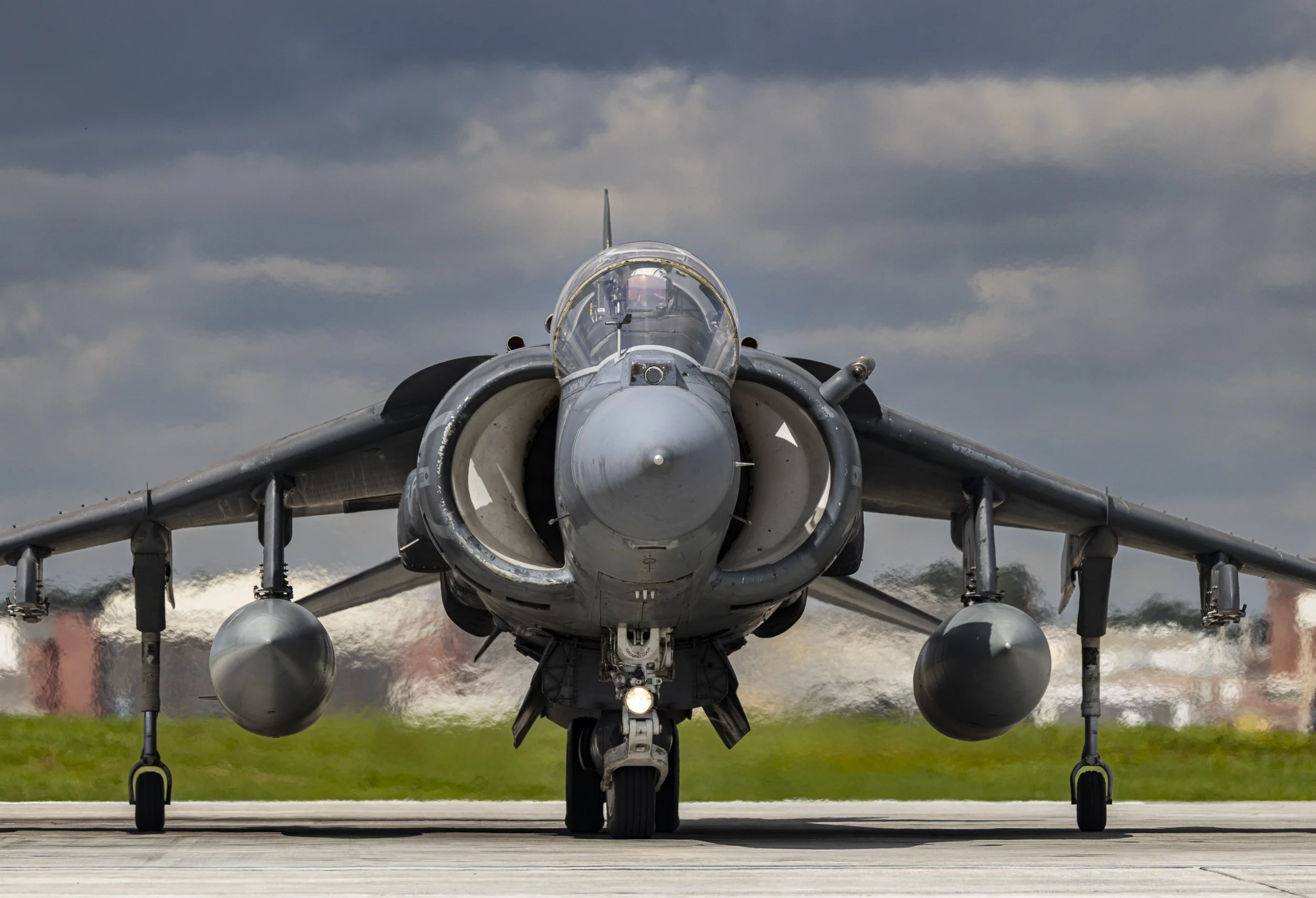
A definitive visual and narrative tribute to the AV-8 Harrier community. More than seventy interviews with the pilots, maintainers, and ordnance Marines who flew, fixed, and armed the jet. A photographic record made over more than three years, through the last sundown flight on June 3, 2026.
CALLSIGN will soon launch a Kickstarter campaign to fund the design and printing of the first edition of Harrier Legacy, a commemorative 136-page deluxe coffee-table softcover book. Every backer reserves a first-edition copy. Higher tiers add special editions, Harrier sundown archival prints, patches, and other exclusive rewards.
The first 48 hours will open with a limited early-bird price, and the waiting list gets notified first. When those special copies are gone, they're gone.
Join the waiting list and be first in line when the campaign opens.