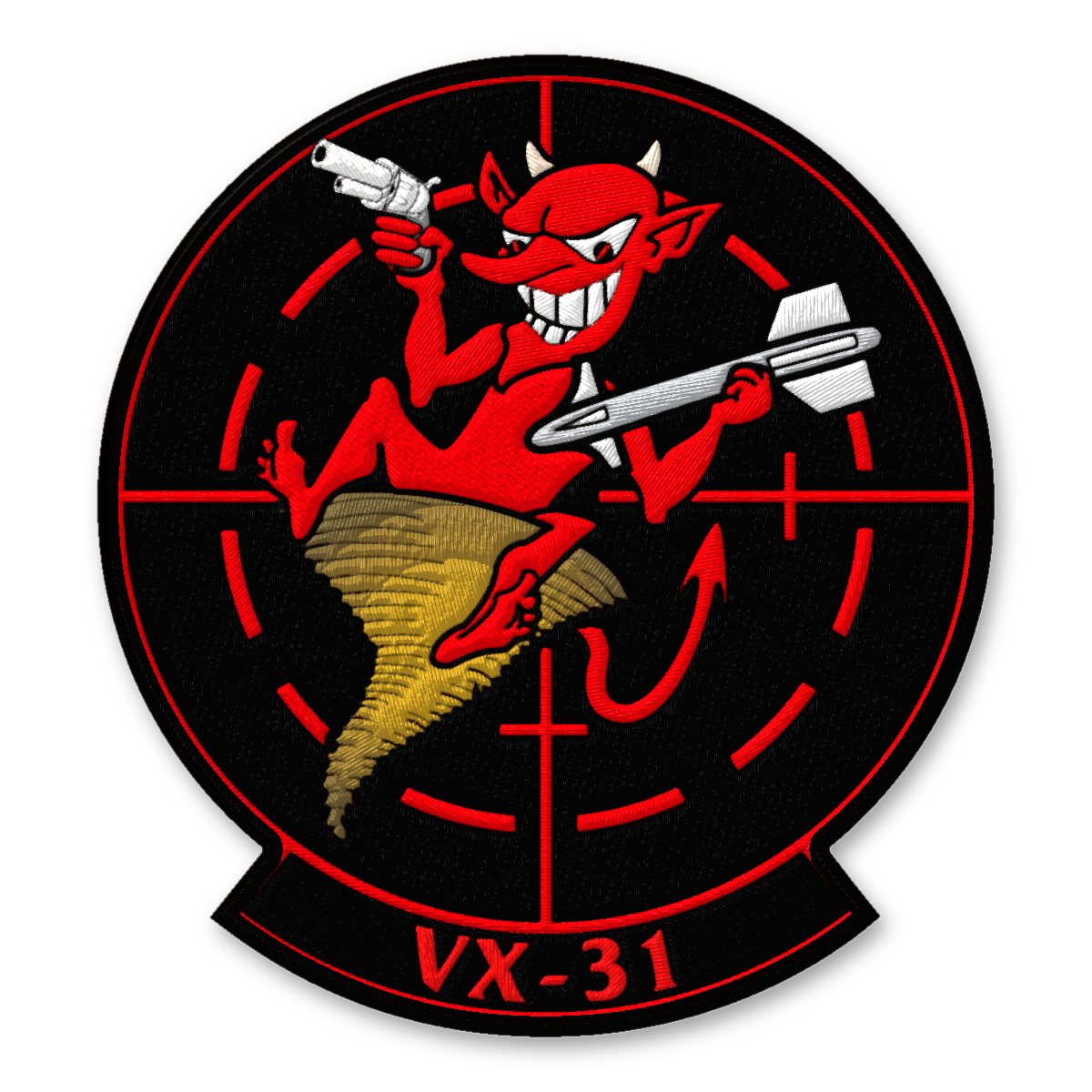
VX-31
Dust Devils — Four Decades of Harrier Testing
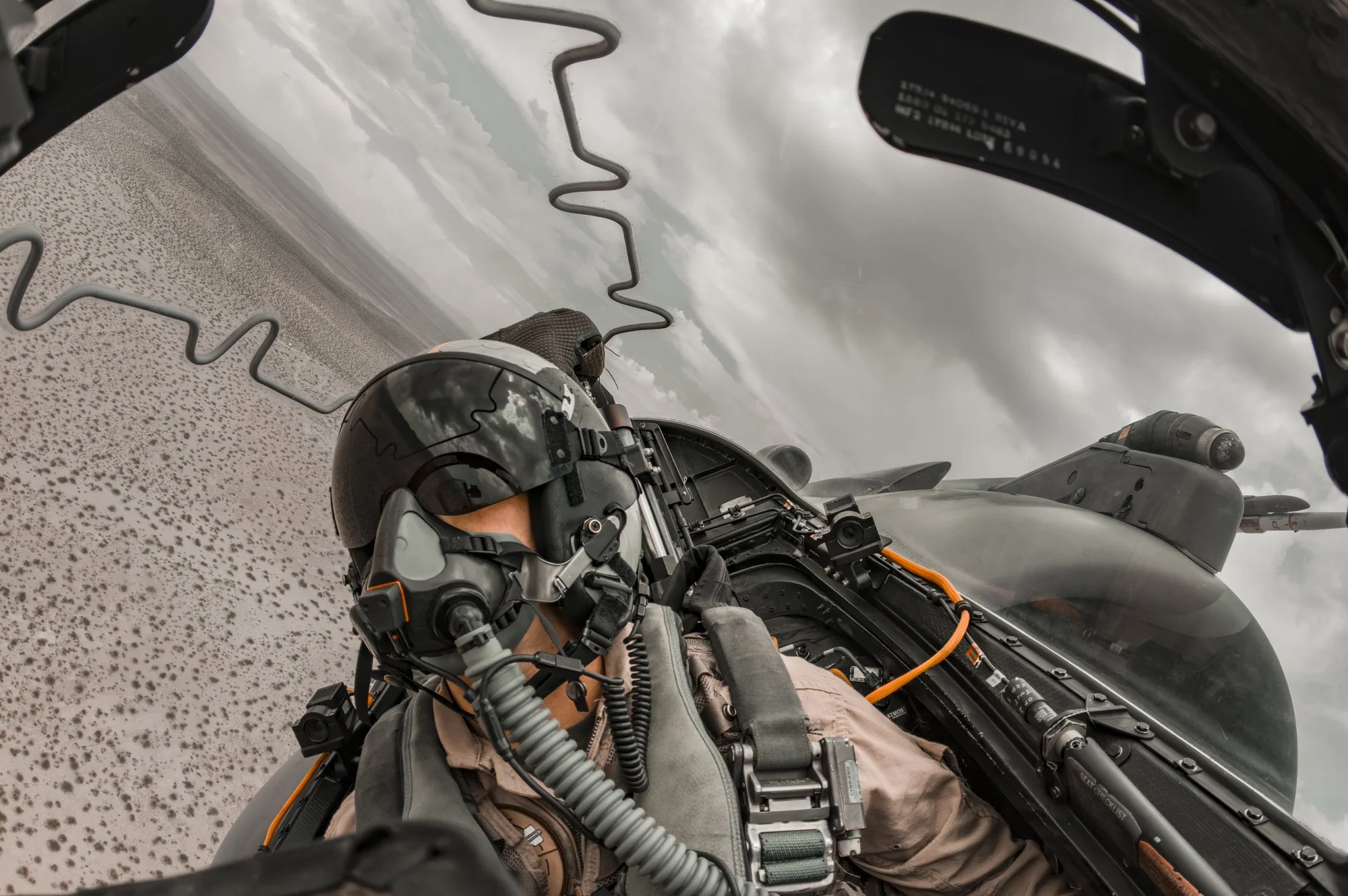
The Harriers at China Lake never went to war, but much of what fleet Harriers carried into combat was tested there first. For about four decades, Air Test and Evaluation Squadron 31 and the test organizations before it flew the AV-8B over the Mojave Desert, testing everything from software and targeting pods to night vision goggles and precision weapons. On September 23, 2025, the Dust Devils flew their last Harrier sortie, ending the Harrier’s developmental testing.
Quick Facts
Nickname: Dust Devils
Harrier years: About four decades of Harrier testing at China Lake, ending September 23, 2025
Aircraft: AV-8B Harrier II, including the radar-equipped Harrier II Plus
Home base: Naval Air Weapons Station China Lake, Calif.
Parent units: Naval Air Warfare Center Weapons Division; Naval Test Wing Pacific
Tail code: DD
Distinction: Flew the AV-8B Harrier’s final developmental test flight and its last test-squadron sortie
Today: VX-31 continues flight testing for the Navy and Marine Corps with the F/A-18E/F Super Hornet, EA-18G Growler, MH-60S Seahawk and other aircraft
The Harrier Years
1977 — China Lake becomes the weapon system support activity for the AV-8B, the start of the station’s Harrier software work.
1980 — On December 10, a modified first-generation Harrier normally based at Patuxent River fires a General Electric 25mm gun at tank targets on China Lake’s G-range, in a Naval Weapons Center test.
1983 — On June 15, the Weapons System Support Facility is dedicated beside Hangar 3 for the F/A-18 and AV-8B.
1988 — In July, after VX-5’s operational evaluation, the Night Attack Harrier prototype transfers to the Naval Weapons Center. In November, 90 members of the AV-8B Weapons System Support Activity receive the Navy Award of Merit for Group Achievement.
1993 — In June, one of the first three Harrier II Plus jets at China Lake goes to the station’s AV-8B Program Office under Maj. Richard C. Branch and Capt. Joseph Rodgers.
1994 — On September 27, Maj. Brooke Paulger ejects unhurt from a Night Attack Harrier shortly after takeoff from Armitage Field. On October 1, the Naval Weapons Test Squadron China Lake, the “Dust Devils,” stands up as a squadron-like unit formed from the station’s Aircraft Department.
1995 — The Naval Weapons Test Squadron becomes its own command under the new Naval Test Wing Pacific, with Cmdr. Randal C. Sweeney as its first commanding officer. The Automatic Target Handoff System, which sends a forward air controller’s target data to the cockpit digitally, is in flight test on the AV-8B.
1996 — On June 17, Maj. James G. Derdall ejects with minor injuries when an AV-8B crashes on Baker Range during a test of a ground proximity warning system.
1997 — JDAM testing on the China Lake ranges is scheduled to include the AV-8B.
1999 — Trials of the Harrier’s OSCAR (Open Systems Core Avionics Requirements) software upgrade are halfway complete at China Lake. On August 30, Col. Kevin E. Leffler, USMC, is killed after ejecting from an AV-8B during a test flight over Saline Valley in Death Valley National Park.
2002 — The Naval Weapons Test Squadron is redesignated VX-31, the Dust Devils.
2003 — Marine test pilot James “Jimbo” Coppersmith joins VX-31 as an engineering test pilot for the AV-8B Joint Systems Support Activity.
2016 — Coppersmith, now retired from the Marine Corps, returns as VX-31’s technical director.
2019 — The Ridgecrest earthquakes destroy the squadron’s hangar.
2025 — Lt. Col. Timothy “Little Buddy” Burchett takes command on March 6. In June, Maj. Alec “Cosmo” Rackish flies the Harrier’s final developmental test flight. Two of the last test jets go to museums in July and August. On September 23, Coppersmith flies the final VX-31 Harrier sortie.
The Mission
Testing the Harrier. VX-31 tested the Harrier as it grew from a day-attack jet into the night-attack AV-8B and the radar-equipped Harrier II Plus. Over the years the Dust Devils tested flight controls, laser targeting pods, night vision goggles, Link 16, precision weapons, survivability systems and biofuels.
“The Jump Jet proved that ‘runways optional’ wasn’t a punchline. It was a revolution.”
— David Halpern, COMMODORE, NAVAL TEST WING PACIFIC
“Over the years, we’ve continued to add more things, more capabilities. … It’s been a non-stop churn of upgrading the Harrier’s system. It’s one of the last true low-level CAS mission aircraft.”
— Tom Krows, FLIGHT TEST ENGINEER
Analog to Digital. The Harrier’s OSCAR program rebuilt the jet’s mission computer and stores-management software, and trials were under way at China Lake by the end of the 1990s. VX-31 flight test director Harvey Pierce called the move from analog to digital the biggest change in the squadron’s Harrier work, because it opened the way for newer weapons.
Software for the Fleet. At China Lake, the AV-8B Joint Systems Support Activity integrated new avionics through software development. As late as 2020, VX-31 was overseeing software upgrades for the AV-8B alongside the F/A-18, EA-18G and MH-60S.
The Final Test. In June 2025, Maj. Alec “Cosmo” Rackish flew the Harrier’s final developmental test flight at China Lake. The Navy said the mission ended more than 40 years of VX-31 Harrier testing.
“This is a pilot’s airplane. There are no computers. It’s cables, pulleys and the skill required to keep that thing in the air.”
— Timothy “Little Buddy” Burchett, COMMANDING OFFICER
The Maintainers
Test flying depends on jets that are ready when the range is. VX-31’s maintainers kept the last Harriers flying to the end. The final jet flew its last sortie fully mission capable, 33 years after its first flight off the production line. After that, the same team demilitarized the squadron’s retiring Harriers and prepared them for museums. The crew’s reputation goes back decades: in 1995 the squadron’s first commanding officer said Harriers were moving from Patuxent River to China Lake because of the efficiency of the Harrier maintenance crew there.
“The engineering feat of bringing four nozzles together to move in the same … synchronicity … using that bleed air off of the engine itself — that was by far the coolest thing that I’ve ever seen.”
— Julie Koch, MAINTAINER
The Pilots
VX-31’s test pilots flew the Harrier’s last developmental test flight and its final sortie from China Lake, and they credited the jet and the team behind it.
“We shut it down full mission capable, and it flew flawlessly. It’s a testament to what we’ve done to this aircraft as a team.”
— James “Jimbo” Coppersmith, TEST PILOT
“It’s a great aircraft to fly, from a pilot perspective, and the mission — you get a rewarding sense out of it pretty much every time I do it.”
— Alec “Cosmo” Rackish, TEST PILOT
The Dust Devils
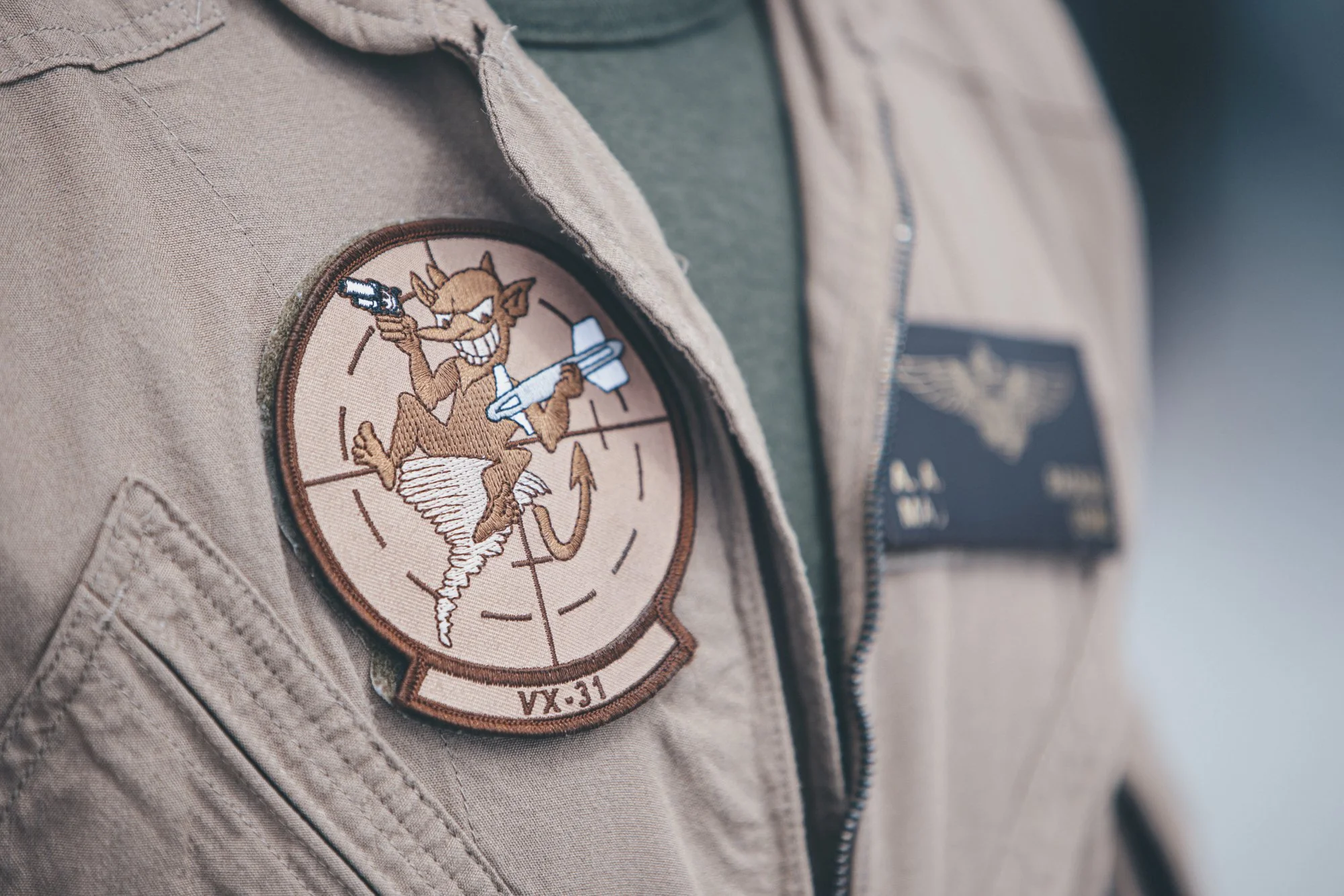
VX-31’s roots go back to China Lake’s early days, when test aircraft were assigned directly to the Naval Air Facility. In 1976 flight operations were consolidated under the Air Department’s Test and Evaluation Directorate. The Naval Weapons Test Squadron stood up on October 1, 1994, became its own command in 1995 and was redesignated VX-31, the Dust Devils, in 2002. When the last Harrier test flight launched in June 2025, the commanding officer’s helmet bore the squadron’s Dust Devil logo.
Awards and Milestones
October 1, 1994 — The Naval Weapons Test Squadron, the “Dust Devils,” stands up at China Lake.
1999 — Harrier OSCAR software trials under way at China Lake.
June 2025 — The AV-8B’s final developmental test flight, flown by Maj. Alec “Cosmo” Rackish.
September 23, 2025 — The final VX-31 Harrier flight, flown by James “Jimbo” Coppersmith at the end of a 29-year, 2,130-hour career in the jet.
Fiscal 2025 — CNO Aviation Safety Award, the squadron’s seventh since 2003, in the year it retired the Harrier.
In Memoriam
Col. Kevin E. Leffler, USMC, was killed on August 30, 1999, after ejecting from his AV-8B Harrier II (BuNo 162721) during a test flight over Saline Valley in Death Valley National Park. He survived the ejection but died after coming down in a rocky canyon in high winds. At the squadron’s sundown, Coppersmith honored the Marines the Harrier community lost over the jet’s service. He said the procedures and engineering changes developed through testing had improved the aircraft’s safety.
“We lost a lot of great Marines along the way, and we honored each of these with every procedure and material solution that improved the safety and reliability of this aircraft.”
— James “Jimbo” Coppersmith, TEST PILOT
This record is still being compiled. If you served with VX-31 and can help us honor the Dust Devils we lost, please share your story.
Commanding Officers, Harrier Era
Cmdr. Randal C. Sweeney — 1995, first commanding officer of the Naval Weapons Test Squadron
Capt. Andrew Gephart — until July 2020
Lt. Col. Dail Fields — July 2020–2022
Cmdr. Christopher “Murdock” Putre — 2022–March 2025
Lt. Col. Timothy “Little Buddy” Burchett — March 2025–October 2026, the squadron’s final Harrier-era commanding officer
This list is still being compiled. If you commanded or flew with VX-31, help us complete it.
Sundown
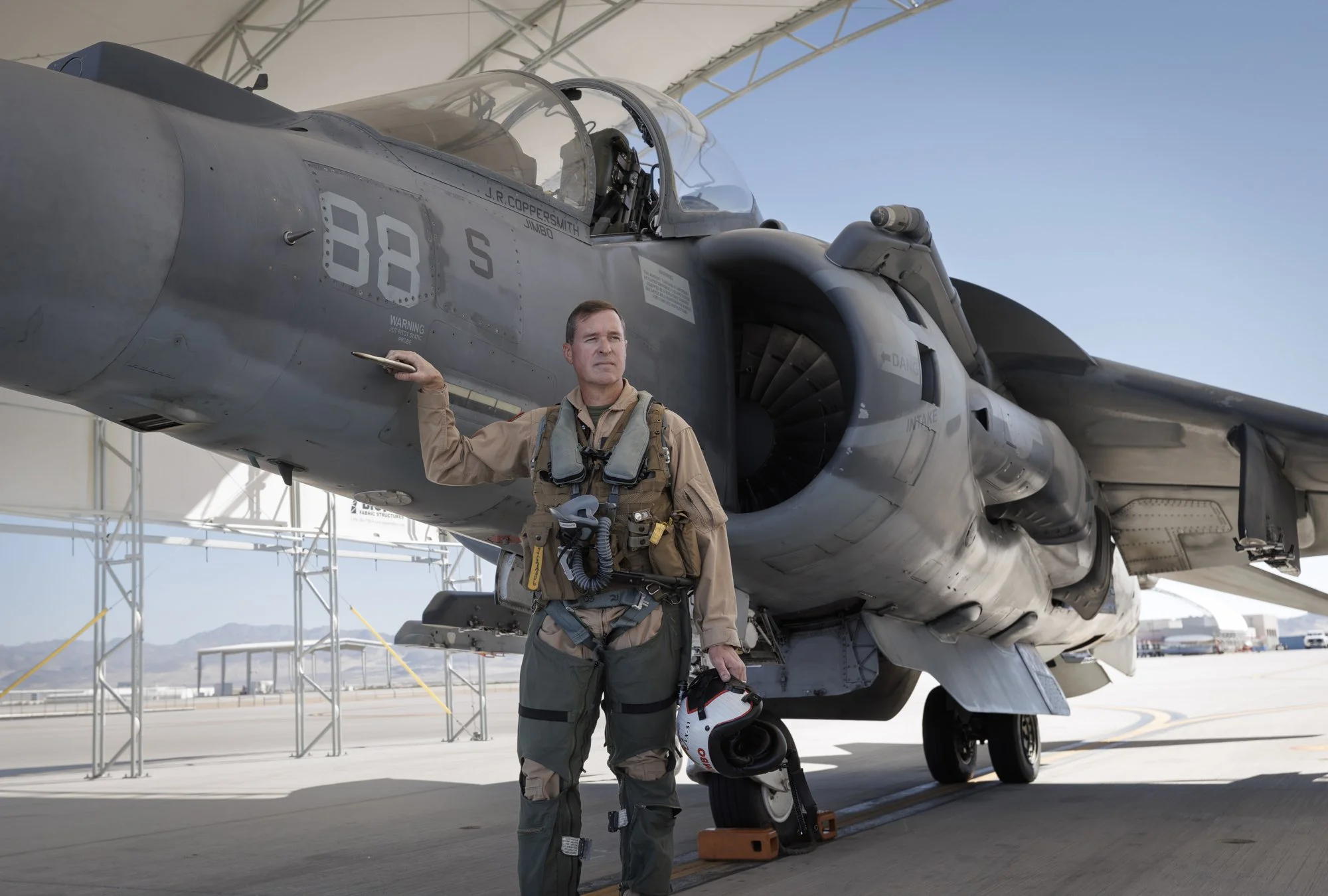
On September 23, 2025, VX-31 held a sundown ceremony at China Lake. Retired Lt. Col. James “Jimbo” Coppersmith, the squadron’s technical director, flew Harrier 88, known as “Christine,” under the call sign “Last 1.” After a final lap over the high desert, he hovered the jet, touched down, lifted off vertically and gave the crowd a brief bow before landing under a water salute from two fire trucks. Veterans, Sailors, Marines, government civilians, industry partners and families were on the flight line.
“To put today in context, the Marine Corps has been in the V/STOL attack business for 54 years.”
— James “Jimbo” Coppersmith, TEST PILOT
“We did not coast into the finish line. It was a triumphant finish for the team partnership.”
— Timothy “Little Buddy” Burchett, COMMANDING OFFICER
Earlier that summer, two of the squadron’s Harriers went to museums. On July 14, Coppersmith flew AV-8B Harrier II Plus BuNo 165579, a jet with 791 combat flight hours, to Merced-Castle Airport for the Castle Air Museum in Atwater, Calif. BuNo 165002 was delivered to the Tillamook Air Museum in Oregon on August 4. That jet had been delivered to the Marine Corps in 1995 and logged 5,518 flight hours, including 631 combat hours, with deployments that included Operation Inherent Resolve in Iraq and Syria.
Today
VX-31 continues as the Navy’s flight test squadron at China Lake, flying the F/A-18E/F Super Hornet, EA-18G Growler, MH-60S Seahawk and other aircraft over the R-2508 range complex. In October 2025, a month after its last Harrier flight, the squadron set up an Unmanned Systems Department.
The Harrier Legacy Project
The Dust Devils’ story is part of The Harrier Legacy Project, CALLSIGN Magazine’s 136-page commemorative book on the Marine Corps AV-8 Harrier community, built from more than two years of embedded reporting, original photography and firsthand oral histories. Learn about the book →
More Harrier Squadrons
VMA-211 Wake Island Avengers · VMA-214 Black Sheep · VMA-223 Bulldogs · VMA-231 Ace of Spades · VMA-311 Tomcats · VMA-331 Bumblebees · VMA-513 Flying Nightmares · VMA-542 Tigers · VMAT-203 Hawks · VX-5 Vampires · VX-9 Vampires
Frequently Asked Questions
What is VX-31? Air Test and Evaluation Squadron 31, the Dust Devils, is the Navy’s flight test squadron at Naval Air Weapons Station China Lake, Calif. For decades it did developmental testing of the Marine Corps’ AV-8B Harrier.
When was the last VX-31 Harrier flight? September 23, 2025, at China Lake. James “Jimbo” Coppersmith, the squadron’s technical director, flew the final sortie.
Who flew the Harrier’s final test flight? Maj. Alec “Cosmo” Rackish flew the AV-8B’s final developmental test flight at China Lake in June 2025.
Where did VX-31’s Harriers go? BuNo 165579 went to the Castle Air Museum in Atwater, Calif., and BuNo 165002 went to the Tillamook Air Museum in Oregon, both in the summer of 2025.
Is the Harrier still flying? Not in the Marine Corps. VMA-223, the last Harrier squadron, conducted the Marine Corps’ final Harrier operations on June 3, 2026. The F-35B Lightning II has replaced it.
Last updated November 2026.