VMA-231
Ace of Spades — Harrier Operations 1973–2025
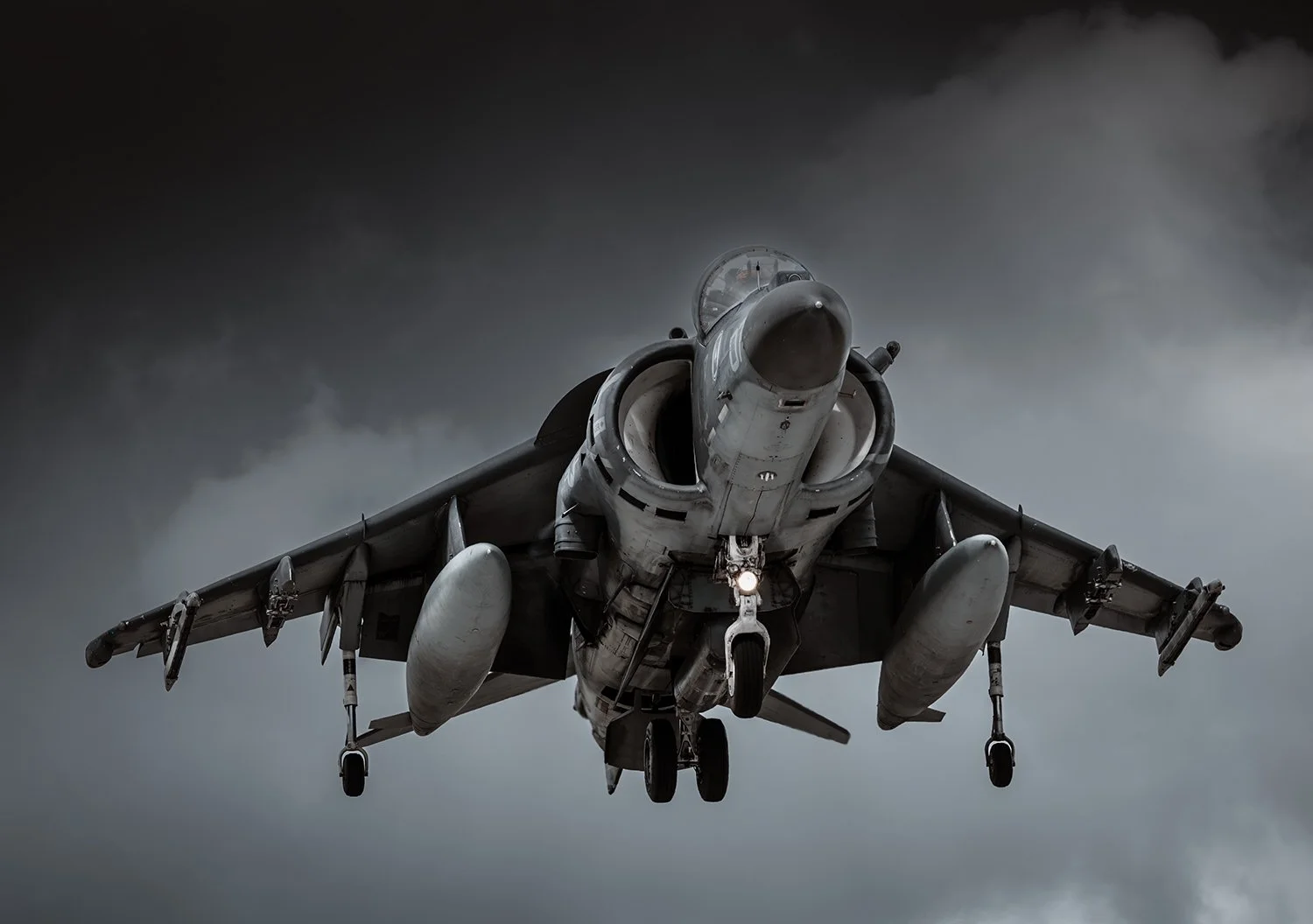
The Marine Corps’ oldest flying squadron spent more than half its life in the Harrier. VMA-231 was reactivated at MCAS Cherry Point on May 15, 1973, as one of the first squadrons to fly the Hawker Siddeley AV-8A, and for the next 52 years the Ace of Spades took jump jets where nothing else with wings could go — off carrier decks and amphibs, onto forward strips in the Saudi desert and the dirt of Helmand Province. The last Spades Harrier landed at Cherry Point on May 29, 2025.
Quick Facts
Nickname: Ace of Spades
Harrier years: May 1973 – May 2025
Aircraft: AV-8A Harrier, AV-8B Harrier II and the radar-equipped Harrier II Plus
Home base: MCAS Cherry Point, N.C.
Parent units: Marine Aircraft Group 14, 2nd Marine Aircraft Wing
Tail code: CG
Distinction: The Marine Corps’ oldest flying squadron, with a lineage dating to 1919
What’s next: VMFA-231, flying the F-35B
The Harrier Years
1973 — Reactivated at MCAS Cherry Point with the AV-8A Harrier.
“For a young Marine, beginnings mean a lot, and 231 is where I learned my trade.”
— Richard Campbell, VMA-231, 1973–75
1975 — First operational deployment: carrier qualifications aboard USS Inchon. Five jets become the first AV-8As to operate from NAS Roosevelt Roads.
1976–77 — Mediterranean cruise aboard the carrier USS Franklin D. Roosevelt with Carrier Air Wing 19, including a transit of the Suez Canal.
1977 — Named the first V/STOL Squadron of the Year.
1978 — First Harrier squadron to operate from an LHA, aboard USS Saipan, and the first transatlantic crossing by AV-8s.
1981 — Half of the first all-AV-8A carrier air wing, aboard USS Nassau.
1985 — Last AV-8A flight on August 2; transition to the AV-8B Harrier II on September 19.
1987–88 — First six-month AV-8B deployment to the Mediterranean, aboard USS Nassau.
1991 — Desert Storm: 987 combat sorties from King Abdul Aziz Air Base, Saudi Arabia.
1990s — Transition to the radar-equipped AV-8B Harrier II Plus. First Plus deployment in August 1996, with the 26th MEU aboard USS Nassau.
2003 — A detachment takes part in the invasion of Iraq.
2007 — Returns to Al Asad, Iraq, flying 1,738 combat sorties.
2009–10 — Afghanistan: Kandahar Airfield and Camp Dwyer.
2016–17 — Operation Inherent Resolve against ISIS, flying from Bahrain.
2019 — Flies into Afghanistan from USS Kearsarge. The squadron marks its 100th anniversary at the National Museum of the Marine Corps.
2023–24 — Final combat deployment, with the 26th MEU aboard USS Bataan.
2025 — Final Harrier flight at MCAS Cherry Point on May 29.
Going to War
Desert Storm. Diverted from the Western Pacific, the Spades flew 18,000 nautical miles in 14 days to join MAG-13 (Forward) at King Abdul Aziz Air Base, rearming and refueling forward at Tanajib. From January 17, 1991, they flew 987 combat sorties and 1,195.8 combat hours — 966.2 of them in February alone, more than any other Harrier squadron in theater — and dropped nearly 1.7 million pounds of ordnance. On February 9, Capt. Russell Sanborn was shot down by a shoulder-fired missile southwest of Kuwait City and held as a prisoner of war until March 6.
“That hit us hard when we didn’t know his fate at the time. … That was chaos after that, but we just kept working … through the night, got aircraft ready to load it overnight again for the next day’s sorties.”
— Mark, VMA-231 ordnance Marine, 1982–1992
The Balkans. Deployed with the 24th MEU aboard USS Kearsarge in 1995, the squadron took part in the rescue of downed Air Force pilot Capt. Scott O’Grady in Bosnia. It flew Operation Deny Flight with the 26th MEU aboard USS Wasp in 1995–96 and Operation Allied Force strikes over Yugoslavia from USS Kearsarge in 1999.
Iraq. In April 2003 a VMA-231 detachment took part in the invasion of Iraq. In the spring of 2007 the squadron deployed to Al Asad Air Base in support of Operation Iraqi Freedom, flying 1,738 combat sorties and more than 5,158 flight hours.
Afghanistan. The Spades took over Harrier operations at Kandahar Airfield from VMA-214 in late 2009. On February 10, 2010, under Lt. Col. David Forrest, they began flying from Camp Dwyer in support of Operation Moshtarak, the assault on Marjah.
Against ISIS. In October 2016 the Spades deployed to Bahrain for Operation Inherent Resolve. Extended from six months to seven, they flew missions of eight hours and more over northern Iraq in support of the fight for Mosul. By the account of then–executive officer Trevor Felter, the squadron made the Harrier’s first land-based combat use of APKWS laser-guided rockets in Iraq.
“We ended up getting extended … and we watched the liberation of Mosul from the sky.”
— Trevor Felter, VMA-231 executive officer
Afghanistan from the Sea. In 2019 a Spades detachment sailed aboard USS Kearsarge and flew seven-and-a-half-hour missions from the ship into Afghanistan in support of Operation Freedom’s Sentinel.
“At one point … we were down to three jets, and we were still doing combat ops.”
— Trevor Felter, 2019 detachment officer in charge
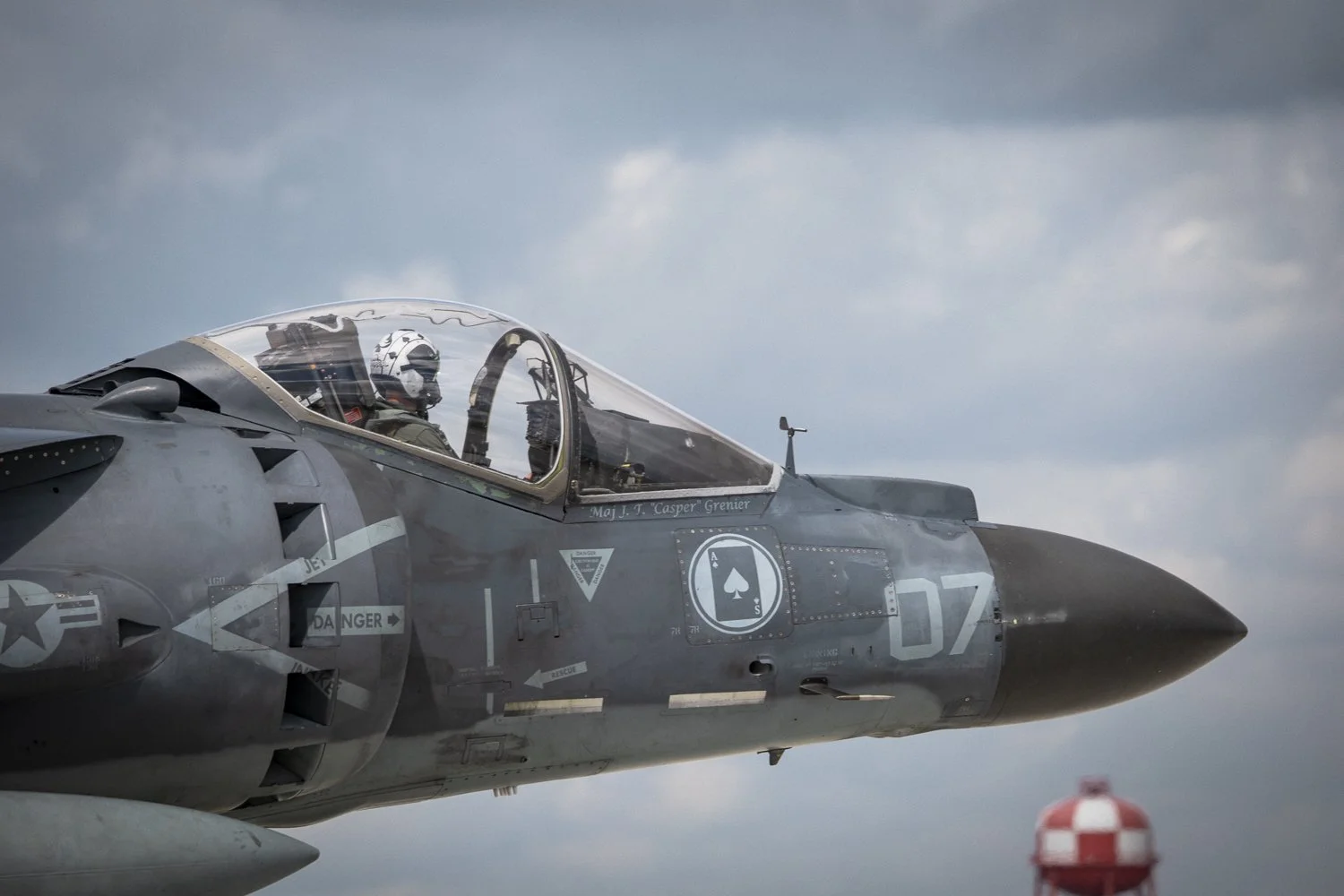
The Red Sea. The squadron’s last combat deployment came with the 26th MEU aboard USS Bataan in 2023–24, flying counter-drone missions over the Red Sea.
At Sea
1979 — USS Tarawa.
1980 — Exercise Teamwork-80 in Norway, aboard USS Saipan and USS Iwo Jima.
1983 — USS Tarawa, with HMM-165.
1986–87 — USS Saipan: Exercise African Eagle and operations off Honduras.
1991 — USS Saipan, 22nd MEU, Persian Gulf.
1992–93 — Split deployment: 14 jets to MCAS Iwakuni, with detachments to USS Belleau Wood; six jets with the 26th MEU aboard USS Saipan.
1995 — USS Kearsarge, 24th MEU.
1995–96 — USS Wasp, 26th MEU.
1996 — USS Nassau, 26th MEU: Albania, Bosnia and Zaire.
1999 — USS Kearsarge, 26th MEU: Allied Force, Joint Guardian and Shining Hope.
2003 — MCAS Iwakuni, attached to the 31st MEU.
2013 — Six AV-8Bs with the 26th MEU.
2018–19 — USS Kearsarge: Operation Freedom’s Sentinel.
2023–24 — USS Bataan, 26th MEU.
The Maintainers
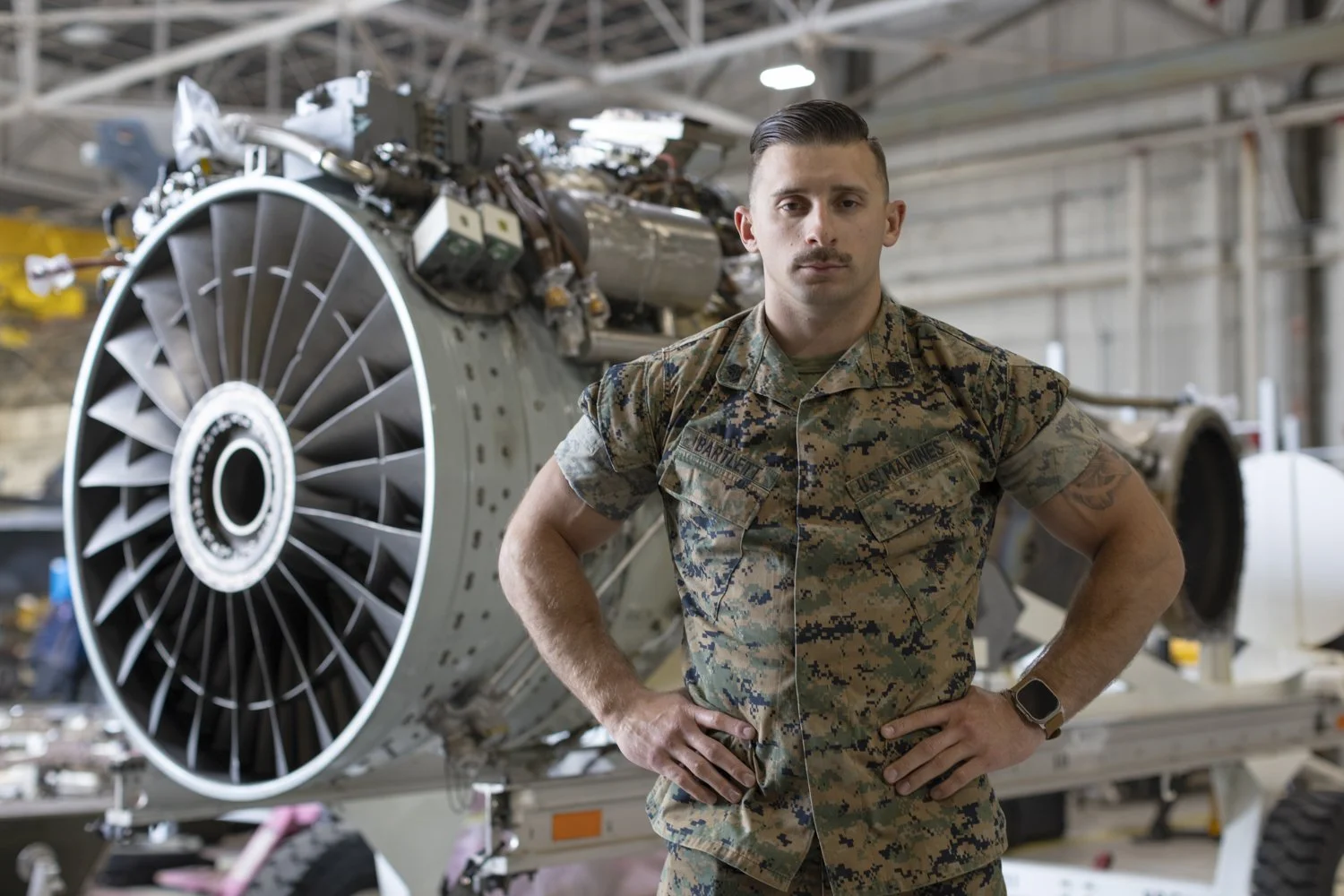
From bombs lifted by hand onto AV-8A racks to 12-hour shifts on desert flight lines, the Spades’ maintainers kept Harriers on the schedule for 52 years.
“Two guys on the front, two guys on the back, and you muscle that thing off the trailer, shuffle around, get underneath the aircraft, and lock it in whatever rack you’re putting it in.”
— Mark, VMA-231 ordnance Marine, 1982–1992
“Maintainers at 231 were probably some of the hardest working maintainers I’ve known in my Harrier time.”
— Trevor Felter, VMA-231 executive officer
“God bless the mechanics all those years … those were the true heroes, in my opinion, in terms of keeping that platform alive.”
— Col. Ben “Lawman” Hancock (Ret.), VMA-231 veteran
The Ace of Spades
VMA-231 traces its lineage to 1919, and the Ace of Spades has marked its aircraft since the biplane era. In the Harrier years, Marines leaving the squadron had their Spades patch taken off and hung on the wall of the squadron’s heritage room. In 2019 the squadron marked its 100th anniversary at the National Museum of the Marine Corps in Quantico, Va.
“To say that you were a Spade. You were a member. It’s a cool thing to say.”
— Col. Ben “Lawman” Hancock (Ret.)
“Being VMA-231, the first and the finest … having that legacy … that was a point of pride that we really relished in.”
— Mark, VMA-231 ordnance Marine
Awards and Milestones
1977 — The first V/STOL Squadron of the Year.
1990–91 — 904 flight hours in a single month, a record for a fleet Harrier squadron, followed by 966.2 combat hours in February 1991.
CNO Aviation Safety Award — 1991 and 1992, and at least four times in all by the mid-1990s.
2007 — 1,738 combat sorties and more than 5,158 flight hours in a single Iraq deployment.
In Memoriam
Capt. Cleve B. Doster — July 3, 1975, near MCAS Beaufort
Capt. Timothy C. Krepps — July 12, 1977, off USS Saratoga
1st Lt. Donald R. Flatlie — April 25, 1985, near NAS Fallon
Capt. William P. “Bull” Delaney — August 10, 1993, MCAS Cherry Point
Capt. Ronald C. Walkerwicz — February 16, 1996, near MCAS Cherry Point
“He was a beloved pilot in the squadron. Everybody liked him.”
— Mark, on Capt. William “Bull” Delaney
“Better men than me had been killed flying a Harrier who did nothing wrong that day except to sign for that jet.”
— Col. Ben “Lawman” Hancock (Ret.)
This record is still being compiled. If you served with VMA-231 and can help us honor the Spades we lost, please share your story.
Harrier Commanding Officers
Lt. Col. Ben Hancock — November 2002–January 2004
Lt. Col. David Forrest — 2010, Afghanistan
Lt. Col. Paul Truog — 2025, final Harrier commanding officer
This list is still being compiled. If you commanded or flew with VMA-231, help us complete it.
Sundown
On May 29, 2025, the Spades flew their last Harriers at MCAS Cherry Point, with Maj. Gen. William Swan of the 2nd Marine Aircraft Wing and Maj. Gen. James Wellons of the 3rd MAW in attendance. “Today is not a sad day,” said Lt. Col. Paul Truog, the squadron’s final Harrier commanding officer. “This is a momentous day for Marine aviation.” The squadron was scheduled to deactivate in September 2025 and return as VMFA-231, flying the F-35B.
“We will soon become the history of the Marine Corps. … We will be shadows on the wall somewhere.”
— Richard Campbell, VMA-231, 1973–75
The Harrier Legacy Project
The Spades’ story is part of The Harrier Legacy Project, CALLSIGN Publishing’s 136-page commemorative book on the Marine Corps AV-8 Harrier community, built from more than two years of embedded reporting, original photography and firsthand oral histories. Learn about the book →
More Harrier Squadrons
VMA-211 Wake Island Avengers · VMA-214 Black Sheep · VMA-223 Bulldogs · VMA-311 Tomcats · VMA-331 Bumblebees · VMA-513 Flying Nightmares · VMA-542 Tigers · VMAT-203 Hawks · VX-4 Evaluators · VX-5 Vampires · VX-9 Vampires · VX-31 Dust Devils
Frequently Asked Questions
When did VMA-231 fly the Harrier? From its reactivation with the AV-8A on May 15, 1973, until its final Harrier flight on May 29, 2025.
Why is VMA-231 called the Ace of Spades? The Ace of Spades has been the squadron’s insignia since the biplane era, and its Marines have called themselves Spades for generations.
Is VMA-231 the oldest squadron in the Marine Corps? Yes. VMA-231 is the Marine Corps’ oldest flying squadron, with a lineage dating to 1919.
What wars did VMA-231 fight in with the Harrier? Desert Storm, the Balkans, Iraq, Afghanistan and the campaign against ISIS, with a final combat deployment to the Red Sea in 2023–24.
Who was VMA-231’s last Harrier commanding officer? Lt. Col. Paul Truog.
What does the squadron fly now? The squadron is transitioning to the F-35B Lightning II as VMFA-231.
Sources and Further Reading
Marine Attack Squadron 231 completes final Harrier flight at Cherry Point, 2nd Marine Aircraft Wing
Marine Attack Squadron 231 completes its final Harrier flight, Seapower
OIR’s “Ace of Spades”, DVIDS
VMA-231, Wikipedia
Interviews conducted by CALLSIGN Publishing for The Harrier Legacy Project.
Last updated September 2026.